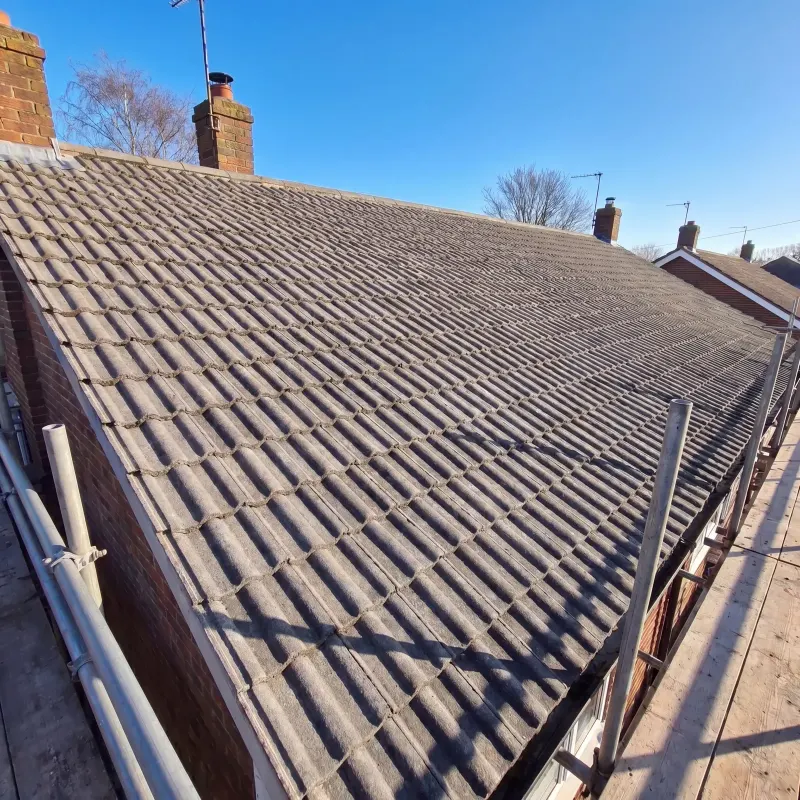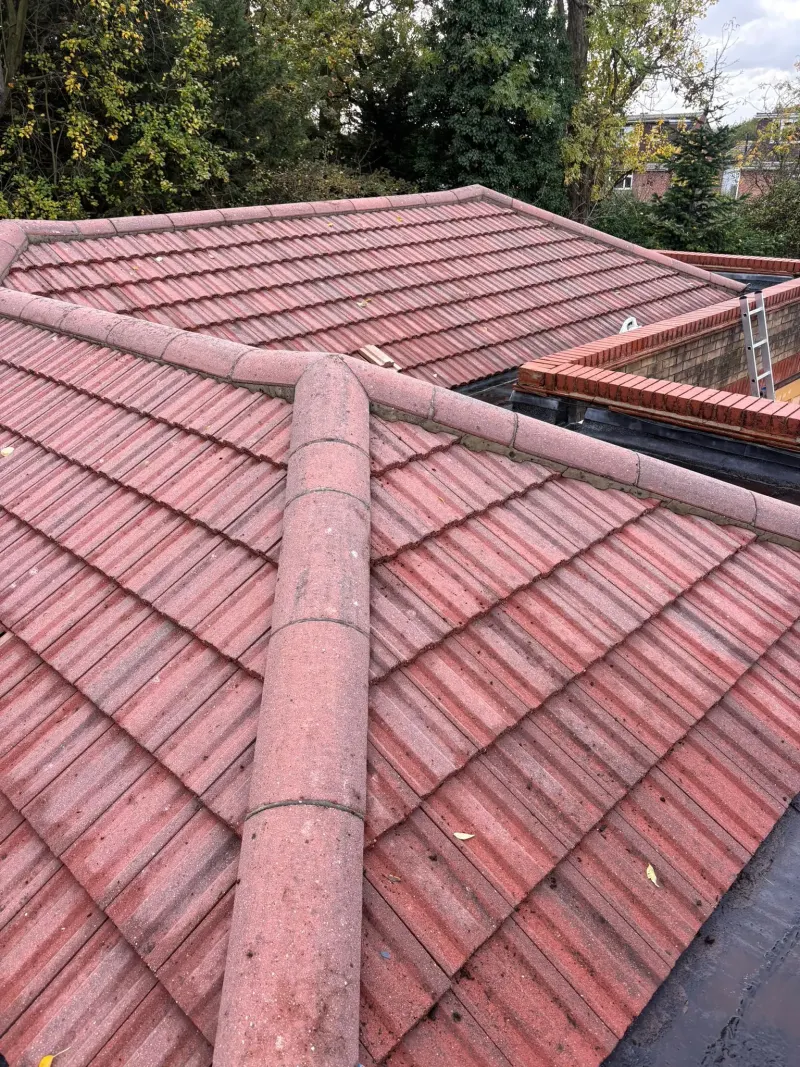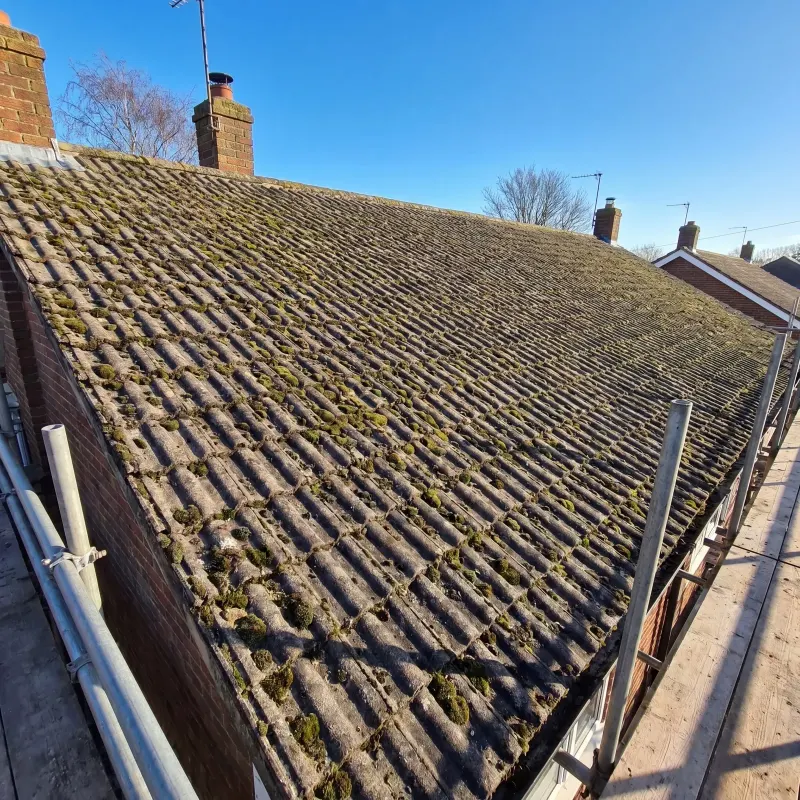
Lichen is the crusty grey, white, yellow or orange spotting on roof tiles. It’s a partnership between a fungus and algae, grows very slowly and grips the tile surface hard. The safe way to remove it is a biocide treatment: it dies quickly, then weathers off with the rain over the following months.
What does roof lichen look like?
Lichen looks like flat, crusty spots or rings stuck to the tile. Colours range from pale grey and white to bright yellow and orange. Unlike moss, it isn’t soft or spongy, and it doesn’t come away when you rub it.
On a lot of Essex roofs you’ll see both. Moss grows in cushions along the laps and edges of tiles, while lichen dots the flat faces in between. Older clay tiles and concrete tiles that have lost their surface coating are the most common places for it.
What exactly is lichen?
Lichen is two organisms living as one: a fungus and an alga (or a cyanobacterium). The alga makes food from sunlight; the fungus gives it a structure and holds on to the surface. Together they can live on bare stone, tile and slate where nothing else would grow.
That partnership is why lichen is so tough. It can dry out completely in summer and come back to life when the rain returns. It doesn’t need soil, and it takes most of what it needs from the air and rain.
Is lichen bad for roof tiles?
Slowly, yes. Lichen anchors itself into tiny pores in the tile surface, and over many years that can roughen the surface and hold moisture against it. On its own it rarely causes a leak, but a roof covered in lichen is usually a roof that is also growing algae and moss, and the combination holds water against the tiles.
The bigger risk is how people try to get rid of it. Lichen grips so hard that scraping or jet washing it off tends to take the tile’s surface with it.
Why doesn’t lichen come off when the roof is cleaned?
Because it dies quickly but lets go slowly. A soft wash and biocide kill lichen on the day. The dead lichen then gradually loosens, fades and is washed away by the rain over the following weeks and months. That’s normal, and it’s the gentle way.
If you want it gone on the day, the only way is force, by scraping or high pressure. On old clay or ageing concrete that does more harm than the lichen ever would.
How long does dead lichen take to disappear?
It varies with the weather, the tile and how thick the lichen was. Light spotting can fade within weeks. Thick, old lichen on a heavily weathered tile can take several months of rain to clear fully. You’ll notice it change colour first, usually going paler, then it starts to flake and wash away.
Can I remove lichen myself?
We wouldn’t recommend going on the roof yourself. Roof work is dangerous without the right access and kit, and tiles are easy to crack underfoot. If you have lichen on a low wall, a garden ornament or a shed roof you can reach from the ground, a soft brush and patience are kinder than a pressure washer.
Is lichen a sign of clean air?
Some kinds of lichen are sensitive to air pollution, so a roof covered in lichen can be a sign of cleaner air. That’s one reason you see so much of it on roofs near the coast and in rural parts of Essex. It’s a nice fact, but it doesn’t make it good for your tiles.
Where in Essex do we see the most lichen?
- Coastal towns such as Southend, Clacton and Burnham-on-Crouch, where damp sea and estuary air keeps roofs wet.
- Old clay-tiled roofs in places like Saffron Walden, Maldon and Colchester’s older streets, where lichen has had decades to establish.
- Ageing concrete tiles across the post-war estates, once the original surface has weathered away.
Does lichen come back after treatment?
Slowly. Lichen is one of the slowest-growing things on a roof, so once a roof has been treated and the dead lichen has washed off, new lichen takes a long time to become noticeable. Keeping the roof treated when moss and algae start to return also keeps lichen down.
What do the different colours mean?
Different species. Grey and white lichens are common on concrete and clay; bright yellow and orange ones are often seen on roofs near the coast and on old tiles. The colour doesn’t change how it’s treated.
Can lichen grow on new roofs?
Yes, but slowly. Lichen needs time to establish, so on a new roof it usually takes years to appear, often first on the shadiest slope or near the coast. Algae and moss tend to arrive first. If you spot early growth on a young roof, a treatment on its own is normally enough to deal with it before it builds up.
What we do about lichen
We lift any loose moss by hand, soft-wash the roof at low pressure and apply a biocide. We don’t scrape lichen off tiles. We’ll tell you on the day what to expect: moss and algae gone, lichen killed, and the remains fading over the following months.
If your roof only has light lichen and little moss, a biocide treatment on its own may be all you need. Send us a photo and your postcode and we’ll say which. Get a free quote.